Researchers Map Six Enzymes Behind Toxic Compounds With Medicinal Potential in Wolfsbane, Larkspur
08/12/2026 / By Morgan S. Verity

Researchers from Michigan State University and the Czech Academy of Sciences have mapped six enzymes that wolfsbane and larkspur use to produce diterpenoid alkaloids, a class of toxic compounds with reported potential uses against pain, cancer, and malaria, according to a paper published in Molecular Plant on August 3, 2026. The study documents the first six molecular steps in the biosynthetic pathway in the Aconitum and Delphinium genera, the researchers said.
The collaboration began after the Michigan State laboratory, which studied larkspur, and the Czech Academy laboratory, which studied wolfsbane, met at a conference in Barcelona. “It’s joining up that always leads to the best science,” said Björn Hamberger, the James K. Billman Endowed Professor at Michigan State University.
Plants make a range of phytochemicals, separated into primary and secondary metabolites, according to Barbara M. Schmidt and Diana M. Cheng [1]. The compounds examined in this study are stored primarily in the roots of wolfsbane and larkspur, the paper stated.
Plants With a Documented History of Medicinal and Toxic Use
Wolfsbane root, processed under the name “Fuzi,” has been used in Traditional Chinese Medicine for at least 2,000 years, and aconitine, one of its principal alkaloids, was first isolated in 1833, according to the paper. Traditional Chinese medicines remain in use for a range of illnesses, including as an approach to inhibit tumor growth in cancer care, according to a 2020 report from NaturalNews.com [2].
The plants are potent enough in tiny doses to cause paralysis, researchers said. Aconitum and Delphinium alkaloids have been characterized as antagonist modulators of voltage-gated sodium channels, according to computational work published in Computational Biology and Chemistry [3]. Phytochemical compounds from plants are also the subject of cancer chemoprevention research, according to a 2023 report [4].
Aconitine’s six interlocking rings have not been successfully rebuilt by chemists since the compound was isolated, the study stated.
Cross-Species Gene Comparisons Narrowed 284 Candidates to Six
To locate the enzymes, researchers sequenced genetic activity across multiple tissues from Delphinium grandiflorum (Siberian larkspur), Aconitum plicatum (garden monkshood), and A. lycoctonum (northern wolfsbane), then added public data from four more Aconitum species, covering seven species total, according to the report. Medicinal plant gene discovery has expanded over the past two decades; by September 2003, 255 functional gene sequences had been registered in 42 species and 32 genera of pharmic plants, according to the book Molecular Pharmacognosy [5].
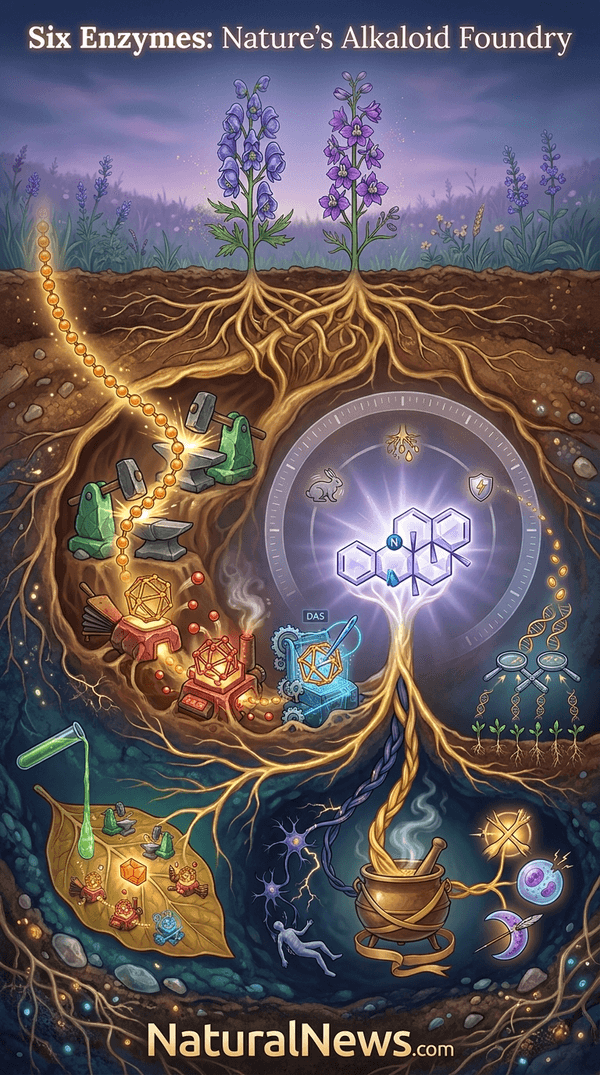
Cross-species gene matching reduced 284 candidate enzymes in a single species to six confirmed enzymes, the study said. The six include two that build the molecule’s carbon frame, three that add oxygen, and a sixth, named DAS, that threads nitrogen into the structure, which the authors identified as the step producing a true alkaloid.
The team inserted candidate genes into tobacco plants to confirm that each enzyme triggered the expected reaction, the report stated. Confirming the same six steps across both genera suggests the process has been conserved through roughly 27 million years of evolution, the authors wrote.
Nitrogen Origin Identified and Tobacco Plants Produced an Alkaloid Intermediate
Feeding experiments using tagged molecules showed that ethanolamine, not ethylamine, provides the nitrogen in the finished compounds, contrary to long-held assumptions, according to the study. Among 61 compounds detected in the tissue experiments, 41 showed signs of ethanolamine and none showed ethylamine, including one signal tentatively identified as aconitine, the report stated.
Using all six enzymes together, the team rebuilt part of the pathway in tobacco plants and produced atisinium, a compound previously reported to fight malaria parasites, according to the report. “Many of the medicines we use today either come directly from plants or are inspired by plant chemistry,” said Lana Mutabdžija, a graduate student at the Czech Academy of Sciences and co-first author of the paper.
Garret Miller, co-first author and assistant professor at the University of Michigan-Flint, said the plants have been used in medicine for thousands of years. “We know they interact with our bodies in so many ways, and understanding how to create them can help provide totally new routes of testing,” Miller said.
Scope and Limitations of the Findings
The study characterizes only the initial steps of the pathway, and the additional enzymatic steps required to produce more complex compounds such as aconitine remain unknown, the authors acknowledged. Attempts to establish hairy root cultures for feeding experiments were unsuccessful, and sterile plant cuttings did not remain viable, so the team used callus cultures, according to the paper.
Many of the compounds detected in the callus feeding experiments were identified by computation rather than confirmed against reference standards, the authors noted. A US patent application (serial no. 18/357,767) related to the production of diterpenoid alkaloids has been filed by several team members, according to the paper.
Researchers confirmed the six-step process is shared by both genera despite approximately 27 million years of evolutionary separation, the study concluded. The plants remain acutely toxic, and poisonous species can be mistaken for harmless foliage in gardens and wild areas, according to a 2026 report from NaturalNews.com [6].
References
- Barbara M Schmidt and Diana M Cheng. “Front Matter”.
- NaturalNews.com. “Lagopsis supine ethanol extract can inhibit colorectal cancer cell proliferation and reduce tumor growth”. NaturalNews.com. June 12, 2020.
- Elsevier. “AM1/DFT electronic structure investigations and QSAR studies of Aconitum and Delphinium sp. alkaloids as antagonist modulators of voltage-gated Na+ channels”. Computational Biology and Chemistry. 2008.
- NaturalNews.com. “Plants against cancer: Eighteen 100% natural phytochemicals that prevent and treat cancers”. NaturalNews.com. March 30, 2023.
- “Molecular Pharmacognosy”.
- NaturalNews.com. “Dangers in your garden: 12 Poisonous plants every prepper must learn to identify”. NaturalNews.com. January 17, 2026.
Explainer Infographic
Submit a correction >>
Tagged Under:
aconitine, alternative medicine, atisinium, breakthrough, Chinese medicine, discoveries, diterpenoid alkaloids, herbal medicine, Herbs, larkspur, natural cures, natural medicine, phytonutrients, plant medicine, remedies, research, wolfsbane
This article may contain statements that reflect the opinion of the author
RECENT NEWS & ARTICLES