Personal Trainer Lists Six Low-Impact Mobility Exercises for People Over 60
09/26/2026 / By Petra Stone
A personal trainer has published a list of six low-impact mobility exercises for adults over 60, according to a report published by Health.com. The six movements are the shoulder shrug and roll, the bent-over Y-T-W, the cat-cow, the “world’s greatest stretch” with downward-facing dog, the glute bridge roll-up, and the 90-90 hip rotation.
The report states that mobility — described as the body’s ability to move through its full range of motion with control — naturally declines with age as muscle mass decreases and the body prioritizes stability over efficiency. According to the report, maintaining mobility is key for staying independent and continuing to perform everyday activities such as reaching for items on a top shelf, opening heavy doors, walking, and picking objects up off the floor. A separate review of more than 20 studies, published in the Journal of Functional Morphology and Kinesiology and summarized by NaturalNews.com, reached a similar conclusion about the role of core stability in physical function [1].
Research summarized in The Okinawa Program, by Bradley J. Willcox, likewise reported that low-impact aerobic activity improves strength, mostly of the lower body, and increases flexibility, especially of the upper and lower limbs and back [2]. The exercise list and the accompanying instructions were attributed by the report to a certified personal trainer.
Shoulder, Spine and Hip Exercises Recommended
The first exercise, the shoulder shrug and roll, may help improve the neck’s range of motion and ease neck pain, according to the report. The instructions state that a person should stand with feet shoulder-width apart, engage the core, and stack the shoulders and rib cage over the hips. The person then raises both shoulders toward the ears, holds for a few seconds, releases, and — with fingertips placed on the shoulders and elbows pointed to the sides — slowly rolls the shoulders backward, then forward, repeating the combination.
The bent-over Y-T-W drill helps warm up the shoulder joints and can build strength and mobility for the muscles around the shoulder blades, the report stated. The instructions describe a hinge at the hips with a slight bend in the knees, followed by lifting both arms overhead into a “Y” shape with thumbs pointing behind, lowering them, lifting them to shoulder height into a “T” shape with palms up, lowering them, and then lifting the arms into a “W” shape with bent elbows aligned with the chest before lowering them and repeating. Research reported by NaturalNews.com on shoulder and neck stiffness noted that a 2023 study of office workers found a high prevalence of scapular dyskinesis, a condition characterized by abnormal shoulder blade movement [3].
The cat-cow, the report stated, guides the spine through flexion and extension and can promote greater spinal mobility. The movement begins in a tabletop position with shoulders stacked over wrists and hips over knees. On an inhale, the tailbone and the crown of the head lift upward, the shoulder blades draw together, and the spine arches; on an exhale, the navel draws in toward the spine and the chin moves toward the chest to round the spine. The report recommends flowing back and forth between the two postures with the breath.
Additional Lower-Body and Full-Body Movements
The fourth movement, described in the report as the “world’s greatest stretch” with downward-facing dog, includes core activation, trunk rotation, and hip extension, according to the trainer, and provides an active stretch in the chest, back, and legs. The instructions begin in a low lunge with the right foot forward and both palms on the ground inside the right foot. The torso rotates to the right with the right hand reaching toward the ceiling; the person then returns to center, places the right palm down, steps the right foot back into a plank, and pushes the hips up into a downward-facing dog. After holding briefly, the person lowers back into a plank, brings the left knee forward, places the left foot outside the hands, and repeats the rotation and dog sequence on the opposite side. A NaturalNews.com report on hip-function exercises by occupational therapist Kevin Shelley described a series of hinge movements intended to decrease back pain, optimize core musculature, and improve postural control [4].
The glute bridge roll-up helps activate the glutes and the muscles necessary for stability in the spine, hips, and pelvis, the report stated, and greater strength in these stabilizer muscles may promote better mobility and may reduce back pain. The instructions call for lying on the back with arms at the sides, knees bent, and the soles of the feet on the ground; the person tucks the hips under, tilts the pelvis back, and lifts the hips toward the ceiling one vertebra at a time before slowly rolling back down. NaturalNews.com, citing trainers, previously recommended basic moves such as glute bridges and split squats, performed with progressive overload, as part of a strength routine [5].
The 90-90 hip rotation brings the hips through internal and external rotation, the report stated, and building hip mobility may support movements such as squatting, walking, climbing, or dancing. The instructions begin seated on the floor with the left leg in front, knee bent 90 degrees and shin parallel to the hips, and the right leg to the side, knee bent 90 degrees and shin perpendicular to the hips. The person sits tall with arms lifted, lifts the knees, and rotates them to the right so that the right leg ends in front and the left leg to the side, then repeats in the other direction. NaturalNews.com reported separately that joint pain after 50 is often a signal from the body’s foundational structures and that the resulting deterioration threatens mobility and independence [6].
Mobility Benefits and Integration Tips
The report states that mobility exercises can be helpful for people of all ages and fitness levels but are especially useful for people in their 60s, when the natural decline in strength and muscle mass — and therefore mobility — becomes more significant. According to the report, performing mobility exercises as part of a fitness routine can slow future declines and help maintain independence with age. A book on clinical Alzheimer rehabilitation lists an exercise program and flexibility work for the neck, ankles, and joints among recommended structured activities for older adults [7], and a prevention-practice text notes that physical mobility problems contribute the most to lost functional independence [8].
The report cites studies indicating that four minutes of resistance training or 20 minutes of simple exercise moves can significantly improve mobility and physical function in older adults with limited mobility. NaturalNews.com, reporting on exercise for seniors, quoted Dr. Navarro, a physician specializing in senior health, as saying, “It’s never too late to reap the benefits of regular exercise” and that no matter how long it has been since a person exercised or how old the person is, some appropriate exercise can boost fitness, energy, and function [9].
References
- NaturalNews.com. “Research Links Core Strength to Improved Movement, Reduced Fall Risk”. July 16, 2026.
- Bradley J. Willcox. “The Okinawa Program How the Worlds Longest-Lived People Achieve Everlasting Health-and How You Can Too”.
- NaturalNews.com. “Study Suggests 10-Minute Stretches to Ease Shoulder and Neck Stiffness for Sedentary Workers”. June 1, 2026.
- NaturalNews.com. “Hinge Exercises for Hip Function: The Epoch Times Details Five Movements”. September 6, 2026.
- NaturalNews.com. “5 Daily Habits to Support Muscle Mass and Longevity, According to Research”. May 28, 2026.
- NaturalNews.com. “Mobility SOS: Decoding joint pain after 50 and the path to preservation”. December 27, 2025.
- Gogia Prem P. “Clinical Alzheimer rehabilitation”.
- Rush Thompson PhD MS PT Catherine. “Prevention Practice and Health Promotion”.
- NaturalNews.com. “Exercise: The fountain of youth for seniors – defying Big Pharma’s toxic drugs and reclaiming natural vitality”. January 27, 2026.
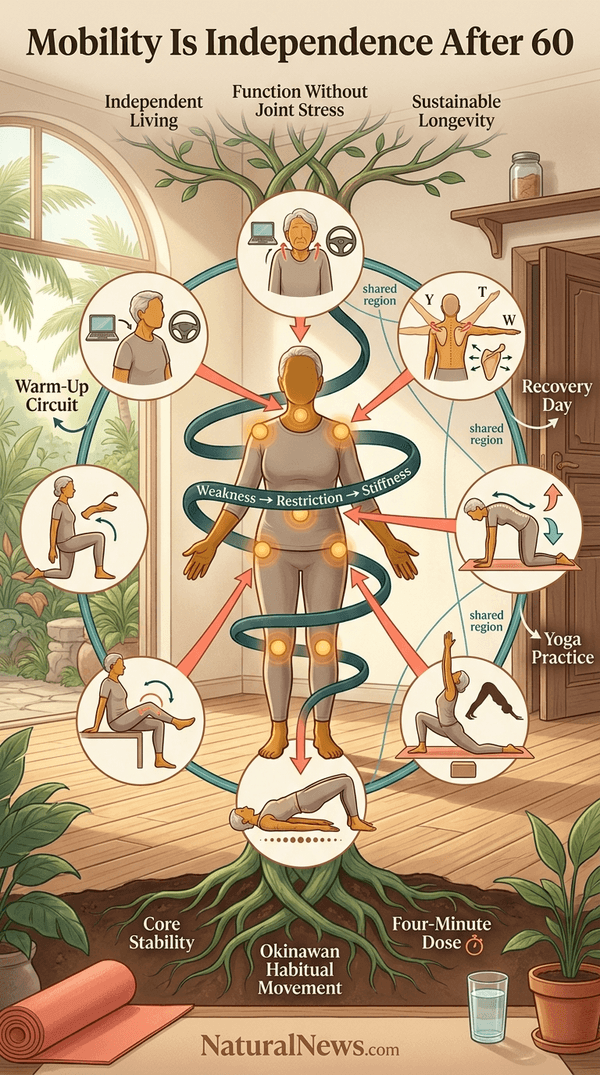
Explainer Infographic
Submit a correction >>
Tagged Under:
alternative medicine, core strength, fitness, fitness routine, longevity, metabolic demand, muscular coordination, natural cures, natural health, natural medicine, Naturopathy, plank, plank exercises, posture, prevention, remedies, research, tips
This article may contain statements that reflect the opinion of the author
RECENT NEWS & ARTICLES