
Pfizer Grants to Nonprofits Preceded Massachusetts Vaccine Exemption Lobbying Letter
09/27/2026 / By Chase Codewell

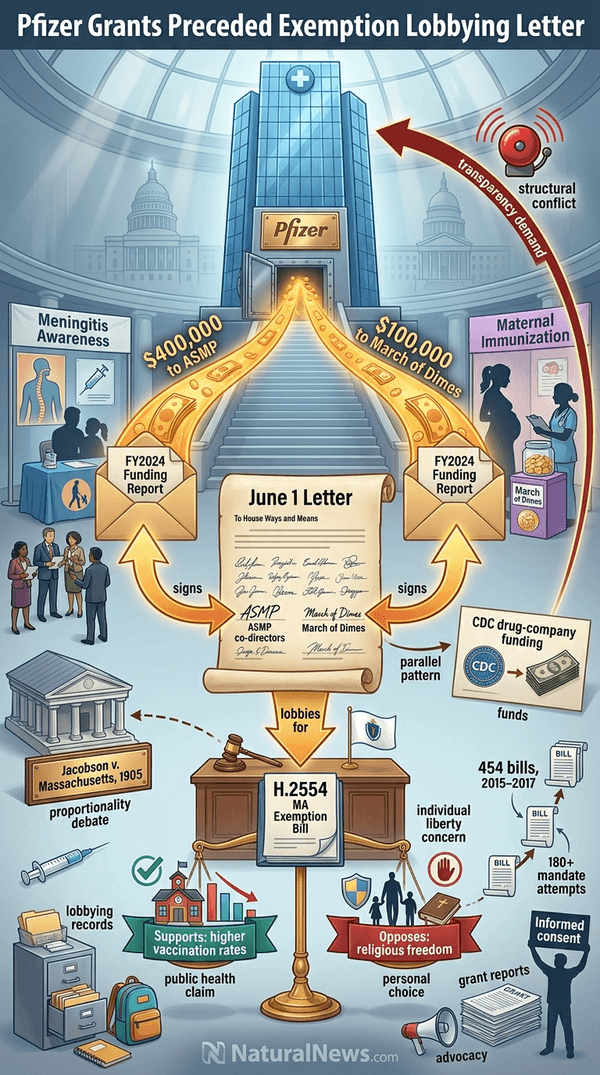
Pfizer paid $500,000 to two nonprofits that later signed a June 1 letter urging Massachusetts lawmakers to advance House Bill 2554 (H.2554), according to the company’s fiscal year 2024 U.S. Medical, Scientific, Patient and Civic Organization Funding Report.
The report lists a $400,000 payment to the American Society for Meningitis Prevention (ASMP) for “Policy Efforts for comprehensive Meningococcal Meningitis Vaccination” and a $100,000 payment to the March of Dimes Foundation (MODF) for a “Vaccine Policy Campaign Maternal Immunization.” More than a year later, both organizations’ names appear among roughly two dozen signatories on the June 1 letter to the Massachusetts House Committee on Ways and Means, according to the letter reviewed by The Defender.
The bill would “remove the non-medical exemption from required school vaccines and enhance data collection and sharing to better track immunization rates,” according to the letter. ASMP’s Co-Executive Directors Patti Wukovits and Alicia Stillman, alongside and Chloe Schwartz, MODF’s director of its maternal and infant health initiative, signed on behalf of their organizations.
Massachusetts Bill Would End Religious Exemption for School Vaccines
Massachusetts currently allows parents to opt their children out of school vaccination requirements on religious grounds. H.2554 would eliminate that option, leaving only medical exemptions, according to the text of the bill and the coalition letter.
Supporters, including the Massachusetts Medical Society, argue that eliminating nonmedical exemptions would raise vaccination rates, as it has in California, Connecticut, Maine and New York, which previously eliminated religious exemptions. They also argue it would reduce the risk of school-based disease outbreaks amid rising exemption rates, according to bill proponents.
As of September 2026, bill-tracking records show that H.2554 was positively reviewed and referred onward, consistent with the coalition letter’s own reference to the bill having “recently reported favorably out of the House Committee on Health Care Financing.” This legislative pattern mirrors a broader national trend: the National Vaccine Information Center documented 454 vaccine-related bills between 2015 and 2017 alone [1], and more than 180 legislative attempts to add mandates or restrict exemptions occurred in just two years, according to prior reporting [2].
Opponents, including Health Action Massachusetts, call the bill a “dangerous attack on religious freedom and educational access” that would force families who decline vaccination on religious grounds to homeschool their children, including children with special needs, regardless of circumstance. The debate reflects long-standing questions about the legal justification for compulsory vaccination.
As legal scholars have noted, the U.S. Supreme Court’s 1905 decision in Jacobson v. Massachusetts created the precedent for mandates during a smallpox outbreak, but the scope of vaccination mandates must be proportionate to the public health threat, and citizens have retained the right to obtain exemptions for medical, religious, and philosophical reasons depending on the state [3].
Disclosures Describe General Vaccine Policy Work, Not Bill-Specific Lobbying
Pfizer’s disclosure does not indicate the money was earmarked specifically for opposing Massachusetts’ religious exemption, according to the report. The stated purposes are broader vaccine-policy campaigns tied to meningococcal disease and maternal immunization.
ASMP separately describes itself as focused on educating young people and parents about meningococcal meningitis. The MODF has publicly credited Pfizer as an “inaugural supporter” of its vaccine-education campaign, describing a partnership that supports work encouraging adherence to the vaccine schedule recommended by the Centers for Disease Control and Prevention (CDC).
Neither ASMP nor the MODF responded to requests for comment from The Defender. Neither organization has publicly addressed the timing of the donations relative to their support for H.2554.
Critics Question Pharmaceutical Funding of Advocacy Groups
Pharmaceutical industry funding of advocacy groups is a long-standing practice, but critics argue it allows companies with a direct financial stake in vaccination mandates to shape public health policy through intermediary organizations rather than lobbying directly. This concern echoes broader criticisms about conflicts of interest in vaccine policy.
As Health Secretary Robert F. Kennedy Jr. and others have documented, the CDC has accepted millions of dollars in funding from drug companies and vaccine makers, fostering a perception of independence while financial ties persist [4]. The arrangement also mirrors tactics seen in other states, including Colorado, where a school district hired lobbyists to support vaccine tracking legislation [5].
Gail Seiler, president of Betrayal Project USA, told The Defender that drugmakers should clearly define their financial ties to advocacy groups that go on to lobby for vaccines. “When pharmaceutical companies provide substantial funding to organizations that then advocate for public policies affecting the use of those companies’ products, the public deserves complete transparency about those financial relationships,” Seiler said.
Seiler also said no parent should be forced to justify a deeply personal medical decision to a corporation, lobbying organization, school system or government official. “Informed consent cannot exist without the freedom to say no,” she told The Defender.
William M. Snyder, an attorney with Protat Snyder Law, called the financial arrangement “another example of Pfizer using its funds to enable non profits to lobby states to eliminate vaccine exemptions.” Bethany Clark of the Kentucky Medical Freedom Coalition told The Defender that monetary arrangements pharmaceutical companies have with larger organizations make it harder for local ones to have an impact.
“It does raise questions about how much influence corporations have over legislation,” Clark said. “As a grassroots organization, it’s difficult to see our efforts to pass pro-medical freedom bills or stop bad legislation and wonder if our seeming inability to move the needle in the last few sessions has anything to do with the deep pockets of organizations with a lot of money at stake in the outcome of that legislation.”
Dr. Chris Flowers extended a critique of the funding structure itself. He told The Defender: “It does not matter whether the product is a vaccine, a software license, or a building material. When the seller finances the advocacy that would force the public to buy it, the conflict is structural.
Flowers noted: “Mandates plus manufacturer funding of the mandate campaign is a combination that should set off every ethics alarm. Paying the messengers who then demand a mandate for your product is not philanthropy. It is sales.” According to Flowers, religious exemptions exist so the state cannot conscript every family into a commercial market.
The structural conflict described by critics is not unique to Pfizer. As investigative journalist Kate Williams has reported, pharmaceutical companies have long embedded political strategists within their operations to shape policy outcomes, with firms explicitly offering to help stakeholders “develop and shape your policy and strategy in a way that assists political stakeholders to understand and embrace the outcome you are seeking” [6].
Industry Defenders Cite Standard Practice and Disclosure
Pfizer and its defenders counter that funding patient- and disease-advocacy groups is standard industry practice disclosed for exactly this kind of scrutiny. They also state that the grants funded general vaccine-policy work, not bill-specific lobbying, according to the company’s position.
Pfizer did not respond to a request for comment from The Defender. The debate continues as Massachusetts lawmakers consider H.2554 and as pharmaceutical funding of advocacy organizations remains a subject of public scrutiny. This controversy unfolds against a backdrop of broader concerns about the erosion of vaccine exemptions nationwide.
As attorney and author Louise Kuo Habakus has written, vaccination choice is not a partisan issue but a matter of ethics, human rights, science, freedom, dignity, and democracy. She notes that unlike manufacturers of almost all other products, vaccine manufacturers in the U.S. are legally free from ordinary tort liability for their “unavoidably unsafe” products, and that the absence of free choice violates fundamental rights [3].
References
- NVIC Advocacy Team. “State Vaccine Legislation in America 2015 to 2017: What the Media, Medical Trade and Pharma Don’t Want You to Know”. Mercola.com. November 8, 2017.
- Dr. Mercola. “Update on the Orchestrated Attacks to Eliminate Vaccine Safety Exemptions”. Mercola.com. November 5, 2017.
- Louise Kuo Habakus. “Vaccine Epidemic”.
- Mercola.com. “This Is Why so Many Health Recommendations Are…” Mercola.com. November 19, 2019.
- GreenMedInfo.com. “Colorado School District Superintendent Hires Lobbyists for Vaccine Tracking Bill”. GreenMedInfo.com.
- Kate Williams. “The Other Side of Vaccines”.
Explainer Infographic
Submit a correction >>
Tagged Under:
. vaccines, American Society for Meningitis Prevention, biased, Big Pharma, conflict of interest, corruption, freedom, grants, health freedom, immunization, Liberty, March of Dimes Foundation, Massachusetts, Massachusetts House of Representatives, medical fascism, medical martial law, Medical Tyranny, money supply, nonprofits, Pfizer, religious exemption, vaccine exemption, vaccine schedule, vaccine wars
This article may contain statements that reflect the opinion of the author